Friday, March 19, 2021

UNIT 13 Organisms And Population Class XII By .Mr Sarjerao Yedekar M.Sc BEd Zoology CTET ,PET

ORGANISM AND POPULATION

INTRODUCTION

  • The study of interaction or inter-relationship of living organisms with their environment is called ecology.
  • Organisms and environment are always interdependent, interrelated or mutually reactive.
  • The term ecology was coined and described by E. Haeckel.
  • The term ecology was first authentically used by Reiter (Father of ecology).
  • Autecology is the study of the inter-relationship of organisms of a species.
  • Synecology is the study of the relation of the group of different species with their environment.

ECOLOGICAL HIERARCHY

  • The hierarchy in the levels of organisms connected with ecological grouping of organisms is called ecological hierarchy.
  • An organism is the smallest unit of ecological hierarchy and basic unit of ecological study. 
  • It may be microscopic (e.g., Amoeba, Chlorella, bacterium) or macroscopic  (e.g., Rose, Mango, Crocodile, Dog, Human being).
  • An organism can be unicellular (e.g., Amoeba, Euglena, Chlamydomonas), colonial (e.g., Volvox) or multicellular (e.g., Fish, Lizard, Mango tree).
  • Each organism is capable of growth, self repair, movement and self regulation of its activities.
  • A group of individuals (members) of the same species living at one place (specific geographical area) constitute a population.
  • Biotic community is a group of organisms of different species that live in common area and which are interrelated and interdependent. It is a natural aggregation of plants and animals in the same environment.
Biotic community = Animal community + Plant community  + Microbial community

ECOSYSTEM

  • Ecosystem is defined as the segment of nature consisting of biological community and its physical environment both interacting and exchanging material.
  • Landscape is a unit of land with natural boundary having a mosaic of patches. These patches generally represent different ecosystems.
  • Biome is a major ecological community or complex community that extends over a large geographical area characterized by a dominant type of vegetation.
  • Biomes are classified in seven categories – tropical rainforest, savannahs, deserts, temperate grasslands, temperate
    deciduous forests, taiga & tundra.
  • The major forest biomes in India are – tropical rainforests, tropical deciduous forest, temperate broadleaf forest and temperate needle leaf (coniferous) forest biome (taiga).
  • Biosphere is the biologically inhabited part of earth along with its physical environment consisting of lower atmosphere, land and water bodies.
  • Environment is the sum total of all the biotic and abiotic
    factors, substances and conditions that surround and potentially influence organisms without becoming their constituent parts.

ORGANISMS AND ITS ENVIRONMENT

  • The constituents of the environment which directly or indirectly influence the form and functioning of organisms in any specific way are known as environmental factors.
  • Climate is the characteristic pattern of weather elements in an area over a period of time with regard to temperature, rainfall, pressure, humidity, wind etc. 
  • Habitat is the physical area covered by any organism.
  • Microclimate and Microhabitat : Sub-division of habitat is called microhabitat. It is an immediate climate (real climate) of an organism which is different from the average climate of the region.
E.g., Forest floor, burrow and surface of desert
  • Ecological niche word is given by Grinnel. It is a specific part of habitat occupied by individuals of a species which is circumscribed by its range of tolerance, type of food, range of environment, microclimate, shelter etc. 
  • Organisms that occupy the same or similar ecological niche in different geographical regions are known as ecological equivalents. 
E.g., Arctic fox and African Jackal, both are scavengers. Grazers of North America and Kangaroos of Australia.
  • The environmental factors are divided into two categories on the basis of their nature – abiotic & biotic factors.

ABIOTIC FACTORS

  • Abiotic or non-living factors affect the structure, behaviour and life history of an organism.
  • Major abiotic factors are – temperature, water, light & soil.

TEMPERATURE
  • Temperature or the degree of hotness/coldness of a place influences the climatic conditions, soil conditions, activities of organisms and growth responses of plants because it influences the rate of all physiological processes.
  • A few organisms can tolerate and thrive in a wide range of temperatures (eurythermal) but the vast majority of them are restricted to a narrow range of temperatures (stenothermal).
  • On the basis of temperature vegetation is divided into four groups:
    • Megatherms : The plants growing in high temperature throughout the year, e.g., tropical rainforest.
    • Mesotherms : The plants growing in alternate high and low temperature, e.g., deciduous tropical forest.
    • Microtherms : Plants growing in low temperature,
      e.g., coniferous forest
    • Hekistotherms : Plant growing in very low temperature, e.g., alpine vegetation.

WATER
  • Water is an important component of protoplasm.
  • Water is a resource, a condition and a habitat in itself. 
  • The productivity and distribution of plants is dependent on water.
  • Some organisms are tolerant of a wide range of salinities (euryhaline) but others are restricted to a narrow range (stenohaline).

LIGHT
  • Light intensity, light direction and light quality control a number of processes of organisms as photosynthesis, growth, movements, photoperiodism, etc.
  • In deep lake, zonation or stratification may be according to the need of light. The different zones of light in aquatic habitat are-
    • littoral zone : shallow coastal region producers occur throughout.
    • limnetic zone : open water zone; oxygen and light decreases with depth.
    • photic zone : light can penetrate.
    • aphotic zone : light does not penetrate
    • benthic zone : bottom zone. 

SOIL
  • Soil is the upper weathered part of earth's surface having mineral particles (45%), water (25%), air (25%), living organisms and humus (5%) which can sustain terrestrial plant life.
  • The study of soil is called edaphology or pedology.
  • It is derived from rocks by weathering which is of three types:
    • Chemical weathering caused by oxidation, hydrolysis or carbonation.
    • Mechanical weathering caused by living organisms, e.g., lichens, grazing animals or earthworm. 
    • Physical weathering caused by water, wind, gravity, glaciers, etc.
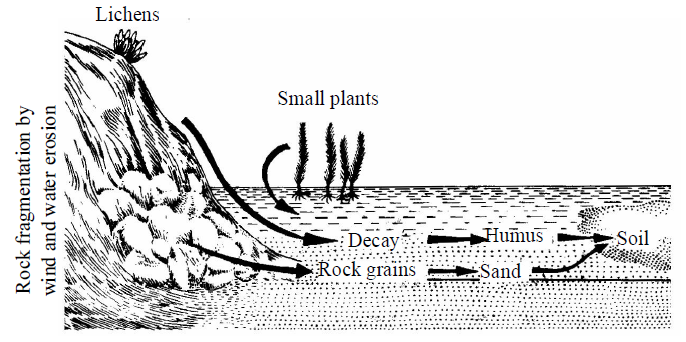
Fig. : The formation of soil 

  • A fully formed soil shows different layers called horizons. The sequence and nature of these layers is called soil profile. 
Cross section of soil consists of following horizons :
  • Horizon 'O' : It is the uppermost horizon made of organic matter. It has both fresh or non-decomposed as well as partially decomposed matter. 
It consists of the following two sub-layers-
    • (i) O1 region (Aoo) : It is uppermost layer which consists of freshly added organic matter such as dead leaves, branches, flowers and fruits.
    • (ii) O2 region (Ao) : Present below O1 region, it consists of organic matter which is in different stages of decomposition.
  • Horizon 'A' : It is rich in mineral elements. A large amount of completely decomposed organic matter is present in this region. 
  • Horizon 'B' : It is dark in colour due to accumulation of leached substances like clay, iron and aluminium from horizon. So it is called the zone of accumulation or zone of illuviation.
Horizon 'O', A and B are together called as top soil.
  • Horizon 'C' : It consists of partially weathered parent rock material. It is called as subsoil.
  • Horizon 'R' : It is the lowermost layer of soil which consists of bed rocks (unweathered).
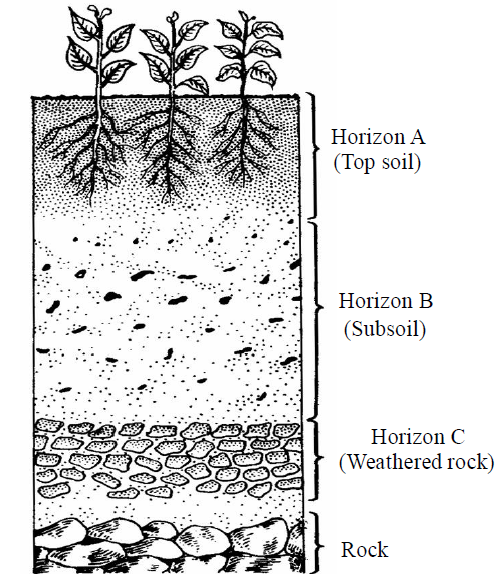
                   
Fig. : Soil profile
  • Various characteristics of the soil such as soil composition, grain size and aggregation determine the percolation and water holding capacity of the soils.
  • Soil is of two types :
    • Residual soil : If the soil remains at the same place where it is formed.
    • Transported soil : If the soil is brought from their place of origin to other place by some agents. It may be : alluvial soil [carried by running water (rivers)], colluvial soil (carried by gravity); eolian soil (carried by wind) and glacial soil (carried by glacier).

NOTES
  • Best pH of the soil for cultivation of plant is 5.5 – 6.5.
  • Excess water produces salinity problem in soil.
  • Calcifuge plants : Those plants which can grow in little amount of calcium in soil (pH - 3.8 to 4.0). E.g. Rhododendron, Rumex etc.
  • The soils of planes of India is mainly alluvial. In India, the principal residual soil types are :
    • Reddish soil of Vindhyas and South.
    • Black soils of South West India.
    • Calcareous soil : With 20% CaCO3.
    • Laterite soil : Oxides of iron and aluminium.
    • Peat soil : With high percentage of humus 90%.
    • Black soil : Predominantly with clay and humus (very fertile because most of the minerals are present in it).


  • Alkaline soil can be corrected by adding gypsum (CaSO4) and heavy irrigation whereas acidic soil can be corrected by adding lime Ca(OH)2.
  • Availability of nutrients from the soil is related to pH of soil.

RESPONSES TO ABIOTIC FACTORS

  • Homeostasis is the maintenance of a constant internal environment in response to changes in –
    • the changing conditions of the external environment.
    • the changing conditions of the internal environment.
  • The various responses to abiotic factors are regulated, conform, migrate & suspend.  
  • Regulators are organisms that try to maintain the parameter at a constant level regardless of what is happening in its environment.
  • All birds and mammals and a very few lower vertebrate and invertebrate species are capable of regulation (thermoregulation and osmoregulation).
  • Conformers are organisms that allow the environment to determine the parameter for instance, ectothermic animals exhibit wide variation in body temperature. Most of the animals and nearly all plants cannot maintain a constant internal environment.
  • Migrate :  The organism can move away temporarily from the stressful habitat to a more hospitable area and return when stressful period is over. Migration involves long distance or short distance movements of animals from one region to another. Like, every winter the famous Keoladeo National Park (Bharatpur) in Rajasthan hosts thousands of migratory birds coming from Siberia and other extremely cold northern regions.
  • Suspend :  Dormancy is a period of arrested plant growth. It is a survival strategy exhibited by many plant species which enables them to survive in climates where a part of the year is unsuitable for growth, such as winter and dry seasons.
  • Hibernation is a mechanism used by many animals to escape cold weather and food shortage over the winter.
  • Aestivation is a state of dormancy induced in some animals by the heat and dryness of the summer.
  • Diapause is a period of inactivity and cessation of growth or development, accompanied by greatly reduced metabolic activity.

ADAPTATION

Plants and animals undergo special characteristic changes in order to live and adjust under prevailing environmental conditions which is called adaptation.

PLANT ADAPTATION
According to various modes of adaptations, plants are grouped into the following major types: 
  • Hydrophytes,  water plants (aquatic plants).
  • Xerophytes or plants growing in xeric (dry) conditions.
  • Mesophytes  or plants growing in mesic (normal water) conditions.

Hydrophytes are divided into five main types:
  • Free floating : They are not rooted in soil, and float freely on the surface of water.
E.g.,  Wolffia - (Smallest Angiosperm, 1mm) - root less
Pistia - Water cabbage has roots.
Lemna - Duckweed - Lemna contains unbranched roots.
Eicchornia - Water hyacinth (Sorrow of Bengal). Its native place is South America. It was brought from Australia to India
Salvinia - Water Fern.
  • Suspended hydrophytes : It remains underwater, and are not rooted in mud. 
E.g.,  (i) Utricularia - Bladderwort. It is a rootless plant. Leaves of this plant is  converted are pocket like apparatus to catch the insect. 
(ii)Ceratophyllum 
(iii) Najas
  • Submerged and Rooted hydrophytes remain underwater, and are rooted in mud. 
E.g., Hydrilla, Vallisneria, Potamogeton, Elodea.
  • Fixed floating hydrophytes : These have fixed roots in mud but the leaves keep floating on the water surface. 
E.g., Trapa, Nymphaea, Victoria (water lily), Nelumbium.
  • Emergent hydrophytes/Amphibious plants : In these plants, the root is fixed in soil and the stem remains partly or completely exposed to air. 
E.g., Jussaea, Juncus, Typha, Sagittaria, Limnophila, Scripus, Ranunculus. Largest group of Hydrophytes.

Adaptations in hydrophytes are
  • Presence of aerenchyma which help in buoyancy or floating. It stores O2 released from photosynthesis. This O2 helps in the plant respiration.
  • Well developed chlorenchyma. All parts of plant take part in photosynthesis except root.
  Exception : In Trapa, roots are photosynthetic.
    • Vascular tissue is poorly developed.
    • Mechanical tissue is less developed.
    • In suspended and submerged plants, leaves are dissected. E.g.,
      • Hydrilla - leaves are genetically dissected.
      • Ceratophyllum - ecologically leaves are  dissected.
      • Vallisneria - leaves are ribbon like.
  • In free floating and fixed floating plants, leaves are broad with entire margin, thick largest leaf, [thickest leaf in Victoria regia (1 m in diameter)]. Rigidity of leaves is due to presence of sclereids (trichosclereids and astrosclereids).
  • Plants grow in dry or xeric conditions are called xerophytes. 
  • Dryness is of two types :
    • Physical dryness : Physically low water quantity in plant habitat. E.g., Psammophytes, Lithophytes, Chasmophytes.
    • Physiological dryness : Optimum water is present in plant habitat but due to some reason, plants can not absorb water. E.g. High salinity, low temperature.
  • Xerophytes is divided into different types : 
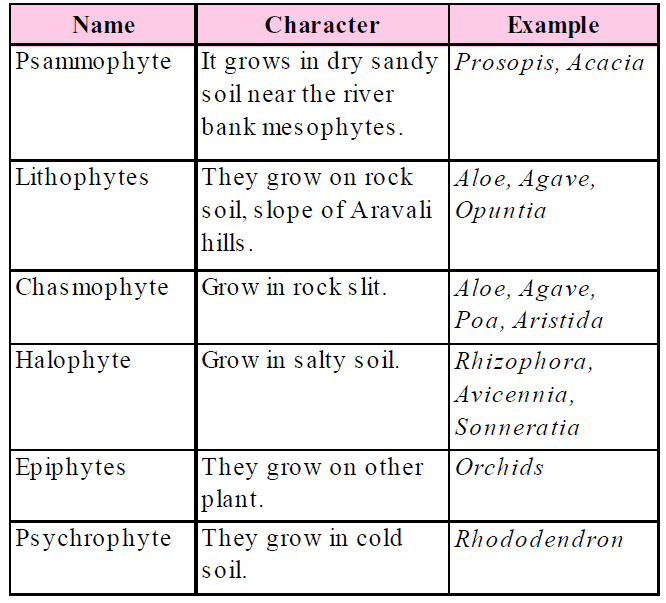
  • A weedy plant growing on the road side or fields where natural vegetation has been disrupted by man is called aletophyte.
  • Helophyte is a marsh plant. It buds over winter under water.
  • Geophyte is a perennial plant that is deeply embedded in the soil substrata.

ANIMAL ADAPTATION
  • Animals adapt themselves for protection from predators, feeding habits, camouflage, mating, adjust to environmental stress conditions.
  • Desert lizard keep their body temperature fairly constant by behavioural means. They bask in the sun and absorb heat when their body temperature drops below the comfort zone, but move into shade when the ambient temperature starts increasing.
  • Kangaroo rat excretes solid urine & can live from birth to death without drinking water thereby, conserving water.

POPULATION

POPULATION ATTRIBUTES

  • Some significant attributes that populations possess are – birth rate / natality, population density, death rate/ mortality, sex ratio, age distribution.
  • Birth rate or natality refers to the average number of young ones produced by birth, hatching or germination per unit time (usually per year). In the case of humans, it is commonly expressed as the number of births per 1000 individuals in the population per year.
The maximum birth rate that a species can achieve under ideal environmental conditions called potential natality. However, the actual birth rate under the existing conditions is much less. It is termed as realized natality.
  • Death rate or mortality is the average number of individuals that die per unit time (usually per year). In humans, it is commonly expressed as the number of deaths per 1000 persons in a population per year. Lowest death rate for a given species in most favourable conditions is called potential mortality, while the actual death rate being observed in existing conditions is called realized mortality.
  • The death rate of a population can be easily represented by survivorship curve. In this curve, time is plotted against the number of survivors.
There are three kinds of survivorship curves–
  • Diagonal curve : If the death rate of different age groups of organisms are equal, then the curve is represented or plotted as a straight line.
e.g., Hydra, mice and many adult birds.
    • Convex curve : When organisms have completed their potential life span and died in old age then the curve is convex, the curves goes horizontal till potential life span and then declines rapidly. e.g., Man, rabbit and many mammals.
    • Concave curve : This kind of curve is mostly found in such organisms who die before their potential life span. e.g., Fish, Oysters and Invertebrates.
  • Sex ratio is the ratio of males to females in a population.
  • Age distribution : Various age groups in a population determine its reproductive status. The three ages referred to as ecological ages in a population are – pre-reproductive, reproductive and post-reproductive. Population with more young members grow rapidly, while the declining populations have a large proportion of older individuals.
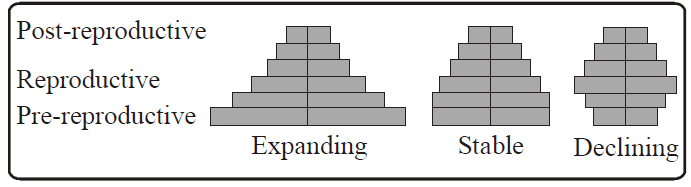
Fig. : Representation of age pyramids for human population

POPULATION GROWTH

  • Population density is the number of individuals present per unit area or volume at a given time. For instance, the number of animals per square kilometer, number of trees per area in a forest, or number of planktonic organisms per cubic meter of water.
  • The population density is determined by four basic processes-natality, mortality, immigration and emigration.
  • The percentage ratio of natality over mortality is known as vital index i.e., natality / mortality × 100. It determines the growth of a population.
  • Immigration is the number of individuals of the same species that have come into the habitat from elsewhere during the time period under consideration.
  • Emigration is the number of individuals of the population who left the habitat and gone elsewhere during the time period under consideration.
  • Change in population size during time interval
= (Birth + Immigration during time interval) – (Death + Emigration during time interval)
The above expression in words may be represented in a simple way by a mathematical model. 
Suppose, N = population size and t = time. The Greek letter delta, (Δ), indicates change. We can now represent change in population as  ΔN, and time interval as Δt. 
The verbal equation can be written as  
ΔN/ Δt = (B + I) – ( D + E ) in which, B = absolute number of births in the population during the time interval, D = the absolute number of deaths during that interval; I = immigrants and E = emigrants. 
I and E , being insignificant, may be ignored. Then the equation simplifies to  ΔN/ Δt =B – D.

MALTHUS THEORY OF HUMAN POPULATION GROWTH 
  • Thomas Malthus, a British political economist, put forward a theory of human population growth in 1778. Malthus in his "Essay on the principle of population" pointed out that population tends to increase in geometric progression while food supply increases only in arithmetic progression. Faster growth of population than of its requirements causes an imbalance between the two. When this imbalance reaches a certain limit, environmental factors like famine, epidemic of a disease, earthquake, flood, war etc. reduce the population to a size, the available resources can support. The factors that control the population size were called positive checks by Malthus.
  • Growth of a population is controlled by an interaction between three factors : biotic potential, environmental resistance and carrying capacity of the environment.
  • Biotic or reproductive potential is the natural capacity of a population to increase at its maximum rate under ideal environmental conditions and stable age and sex ratios. Biotic potential in the human female is estimated to be about 12 per female during its reproductive period between puberty and the menopause period.
  • Environmental resistance : In nature, full biotic potential of an organism or population is never realized, since conditions are rarely ideal. Various harmful environmental (abiotic) factors like non-availability of food and shelter, natural calamities like drought, cloud bursts, floods, fires, temperature fluctuations, accidents, etc. and certain biotic factors like pathogens, parasites, predators etc. check the biotic potential from being realized. The sum of all these inhibitory factors is called environmental resistance. 
  • Carrying capacity is defined as the "feeding capacity of an environment of an ecosystem for a population of a species under provided set of conditions". When a population reaches the carrying capacity of its environment, the population has zero growth rate. So the population generally stabilizes around the carrying capacity. The carrying capacity of the earth for human population is considered to be about 8 to15 billions.
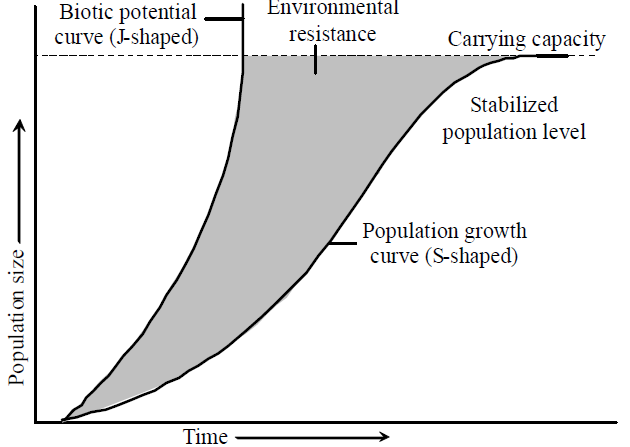
Fig. : The theoretical relationships between biotic potential, environmental resistance and carrying capacity

  • The populations are not stable and do change due to a number of extrinsic as well as intrinsic factors. 
  • These variations in the population size are of two types : population fluctuation and population cycles.
  • Population fluctuations or irruptive variations : In these changes, population density tends to fluctuate irregularly above and below some steady-state level. These are characterized by sudden increase in population in a short time which is followed by equally quick decrease in population size. These are caused by random seasonal or annual changes in the availability of resources (food or energy) or extrinsic factors (E.g., temperature, rainfall etc.). E.g., more birds during early summer due to their hatching period, more insects during summer months and more weeds in the rainy season.
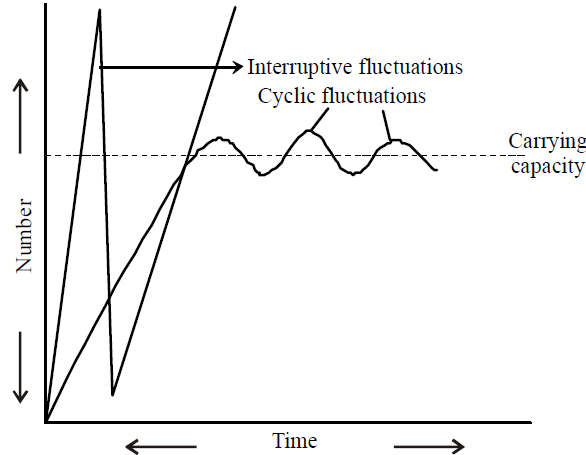
Fig. : Cyclic and interruptive fluctuations in populations

  • Population cycles : These are regular changes in the population size. In these, population size is nearly constant over a long period of time. These are caused by seasonal changes in environment. E.g. population cycles (of 3 to 4 years) of lemmings of Tundras (Elton, 1942), Lemmings (Lemmus lemmus) (small mouse-like rodents found in arctic regions of Canada and Norway) increase in their number for a period of about 3 years when it reaches a peak beyond the carrying capacity of that area. They eat up all the available food. In the winter months, the lemmings migrate in large numbers in the sea and swim till they are drowned due to exhaustion. The surviving lemmings multiply and repeat the process.

GROWTH CURVES
(A)  Sigmoid or S-shaped growth curve
It is shown by yeast cells and most of the organisms. 
It is formed of five phases :
  • Lag phase:  In this phase, individuals adapt themselves to the new environment, so there is no or very little increase in population.
  • Positive acceleration phase:  It is the period of slow increase in population in the beginning.
  • Logarithmic or exponential phase : It is the period of rapid rise in population due to the availability of food and the requirements of life in plenty and no competition.
  • Negative acceleration phase : In this again, there is a slow rise in population as the environmental resistance increases.
  • Stationary (Plateau) phase : Finally, growth rate becomes stable because mortality and natality rates become equal to each other. So, there is zero growth rate. A stable population is said to be in equilibrium, or at saturation level. This limit in population is a constant (K) and is imposed by the carrying capacity of the environment.
S-shaped curve is also called logistic curve. Sigmoid growth curve was described by Verhulst, (1839).
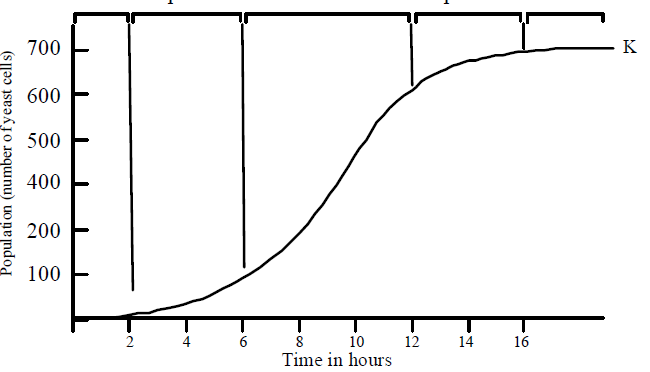
Fig. : The S shaped growth curve of Yeast cells

Population exponential growth equation is given below : Nt = N0 e–rt
where,
Nt = Population density after time t.
N0 = Population density at time zero.
r = intrinsic rate of natural increase.
e = the base of natural logarithms (2.71828).
The equation describes the exponential or geometric growth pattern of a population and results in a J-shaped curve. The J-shaped curve of exponential growth is characteristic of some population that are introduced into a new or unfilled environment or whose numbers have been drastically reduced by a catastrophic event and are rebounding.

(B)  J-shaped Growth curve
It is shown by small population of Reindeer experimentally reared in a natural environment with plenty of food but no predators. This type of population growth is also called Verhulst Pearl Logistic growth. 
It has only two phases :-
  • Lag phase : It is period of adaptation of animals to new environment so and thus, is characterized by slow or no growth in population.
  • Logarithmic or Exponential phase : It is characterized by rapid growth in a population which continues till enough food is available. But with the increase in reindeer population, there is a corresponding decrease in the availability of food and space which finally becomes exhausted leading to mass starvation and mortality. This sudden increase in mortality is called population crash. Lemming of tundra, some insect, algal blooms and annual plants also show J-shaped curves. The population growth curve is S-shaped in most of the organisms. Human population also shows S-shaped curve.

Verhulst-Pearl Logistic Growth equation is given below–

Where,  N = Population density at time t.
r = Intrinsic rate of natural increase.
K = Carrying capacity
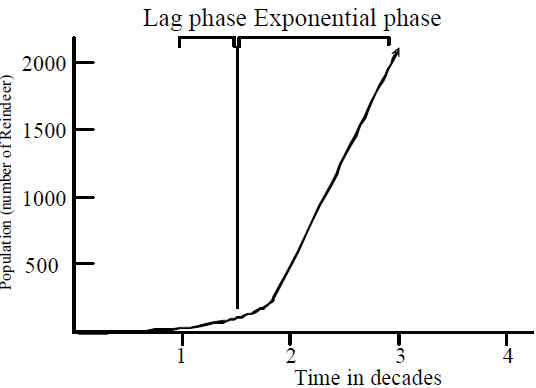
Fig. : The J- shaped growth curve of Reindeer

POPULATION INTERACTION

  • Members of biotic community depends upon one another for food, reproduction, dispersal & production, the phenomenon is called species interdependence interaction.
  • Types of interactions that occur amongst different members of biotic community are–positive and negative.
  • In positive or beneficial interaction, members of one or both the interacting species are benefitted but neither is harmed.
  • In negative interaction, one or both the interacting species is harmed.

POSITIVE OR BENEFICIAL INTERACTION
  • It is a widespread phenomenon. It includes mutualism, commensalism, proto-cooperation, scavenging etc.
  • Mutualism (+/+) or Symbiosis : (coevolution) :
    • It is a positive interspecific interaction in which members of two different species completely depend on each other for growth and survival. 
    • Physical contact is present in between both the interacting species. 
    • It is an obligatory relationship.
    • Examples –
      • Mutualism between animal and animal-
E.g., Termites and aflagellates (Trichonympha) 
  • Mutualism between plant and animals 
E.g.,  (a) Zoochlorella and Hydra.
(b) Yucca plant flowers and Pronuba insects -Pollination of Yucca plant by pronuba (Female yucca moth)
  • Mutualism between plant and bacteria 
E.g., legume plant and Rhizobium.
  • Mutualism between algae and higher plant 
E.g., Nostoc, Anabaena and Anthoceros plant.
  • Mutualism between algae and fungi
E.g., Lichens.
  • Mutualism between fungi and higher plants
E.g., Mycorrhizal association 
  • Commensalism (+/0) 
    • It is an association between members of two species in which one is benefited while the other is almost unaffected.
    • Examples –
      • Lianas : Lianas are woody plants. Their roots are present in soil but their stem uses other plants or objects for support to get better light. They are found in dense forest. No nutritional relationship is present. Lianas are the speciality of tropical rainforest. E.g., Bauhinia, Tinospora
      • Epiphytes : Those small plants which grow on other plants in tropical rainforest. They utilize the only the space of host plant for light and humidity.
E.g., Orchids, hanging mosses.
  • Epizones : Those animals which depend on plants or other animals. E.g.,
Sucker fish (Echeneis) – Shark
Pilot fish – Shark
E. coli bacteria – Intestine of man
Clown fish  – Sea anemone
Barnacles – Whale
Cattle ergot birds – Cattle
  • Proto-cooperation (+/+)  
    • It is an association in which both the organisms are benefited but can live separately. 
It is a facultative or optional or occasional association. It is also called as non-obligatory relationship. 
    • Examples –
      • Hermit crab – Sea anemone
      • Tick bird (Red-billed or yellow billed) – Rhinoceros
      • Crocodile – Bird
      • Plants with both self and cross fertilization.
  • Scavenging is an association in which one partner (called scavenger or saprobiont), eats the dead bodies of other animals, which have died naturally or have been killed by another animal. E.g., Jackal, Vulture, Ant, Crow.
  • Helotism is an association between two organisms, when one behaves as a master and another as a slave. E.g., Lichen.

NEGATIVE INTERACTION (ANTAGONISM)/DETRIMENTAL
  • Types of negative interaction are exploitation, amensalism and competition.
  • Exploitation 
    • One species harms the other by making direct or indirect use of it for support, shelter or food.
    • It is of two types : parasitism and predation.
    • Parasitism (+/–) : This association involves individuals of two species of different sizes in which the smaller (parasite) is benefitted and the larger (host) is harmed. The parasite gets nourishment and shelter from host but does not kill the host.
    • Types of parasite :
    • Ectoparasite : Lives on the body of the host. E.g.,–
      • Ectozooparasite : leech on cattle, ticks on dogs, sandfly on man.
      • Ectophytoparasite : aphids, lac insects, red cotton bug
    • Endoparasites : Live in the body of the host. E.g., Tapeworm, Taenia, Ascaris, Entamoeba → Live in intestine of man.
Plasmodium → Lives in R.B.C. of human.
  • Hyperparasitism : A parasite living on another
    parasite.E.g., Plasmodium on female Anopheles mosquito, bacteriophages on bacteria.
  • Brood parasitism :  Parasitism in which the parasitic bird (cuckoo) lays its eggs in the nest of its host (crow) and lets the host incubate them, this relation is known as brood parasitism.
  • Holoparasite :   Parasite which are totally dependent upon the host for their requirement
E.g., Rafflesia (Total root parasite).
         Cuscuta (Total stem parasite).
  • Hemiparasite :  Parasite which partially depends on the host.
E.g., Viscum – on oak and Loranthus – on mango. Both are partial stem parasites. Santalum is a partial root parasite.
Note : Arceuthobium is the smallest parasite.
  • Predation (+/–) : A free living organism which catches and kills another species for food.
E.g.,
Insectivores fungi : Dactylella, Dactylaria, Arthrobotrys
Carnivores animals : Lion, snake
Insectivores plants : Drosera, Utricularia, Nepenthes

  • Amensalism (–/0)
    • In this interaction, one species is inhibited by the toxic secretion of another species. Inhibitor species is neither benefited nor harmed.
    • Type of amensalism are antibiosis and allelopathy.
    • Antibiosis – secretion of antibiotics E.g.,
      • Penicillium fungi secretes penicillin which inhibits the growth of Staphylococcus bacteria.
      • Chlorella algae secretes bacteriocytes which not only kill but also inhibit growth of the bacteria.
      • Microcystis (BGA) secretes hydroxyl amine which causes the death of fishes.
    • Allelopathy is the secretion of toxic chemicals and the plant is always harmed in this case. E.g.,
      • Parthenium : Trans Cinnamic acid is secreted by Parthenium which inhibits the growth of some plants like Cassia tora and Vincaregia. This phenomenon is known as allelopathy.
      • Sunflower, barley, sorghum, Occimum also show allelopathy.
      • Silver oak shows autopathy - It destroys its own seed.
  • Competition
    • Interaction between two species, where both suffer adverse effects is known as competition.
    • It is of 2 types – interspecific and intraspecific.
    • Interspecific competition occurs between two individuals of two different species occurring in the same habitat.
    • Intraspecific competition occurs between individuals of the same species for mating, food etc.

Friday, December 4, 2020

Short Imp point For NEET MHCET Unit 6 Biomolecules By Prof.Sarjerao Yedekar M.Sc B.Ed Zoology CTET Ahilyadevi Holkar Junior College Pusegaon

Chapter 6 Biomolecules

POINTS TO REMEMBER By Prof.Sarjerao Yedekar M.Sc Zoology BEd CTET 


Biomolecules : All the carbon compounds that we get from living tissues.


Micromolecules : Molecules which have molecular weights less than one thou- sand dalton.


Amino acids : 
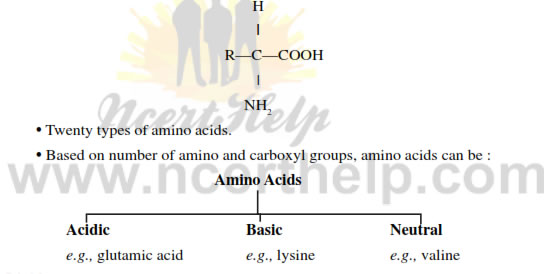
Organic compounds containing an amino group and one car- boxyl group (acid group) and both these groups are attached to the same carbon atom called α α α α α carbon.


Lipids :
• Water insoluble, containing C, H, O.
• Fats on hydrolysis yield fatty acids.
• Fatty acid has a carboxyl group attached to an R group (contains 1 to 19 carbons).
• Fatty


Acids : Saturated With single bonds in carbon chain. e.g., Palmitic acid, butyric acid.


Unsaturated : With one or more double bonds. e.g., oleic acid, linoleic acid.


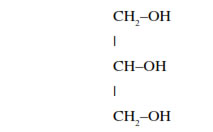
Glycerol : A simple lipid, is trihydroxy propane.


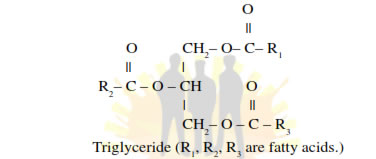
• Some lipids have fatty acids esterified with glycerol.
• They can be monoglycerides, diglycerides and triglycerides.


• Phospholipids are compound lipids with phosphorus and a phosphory- lated organic compound e.g., Lecithin .


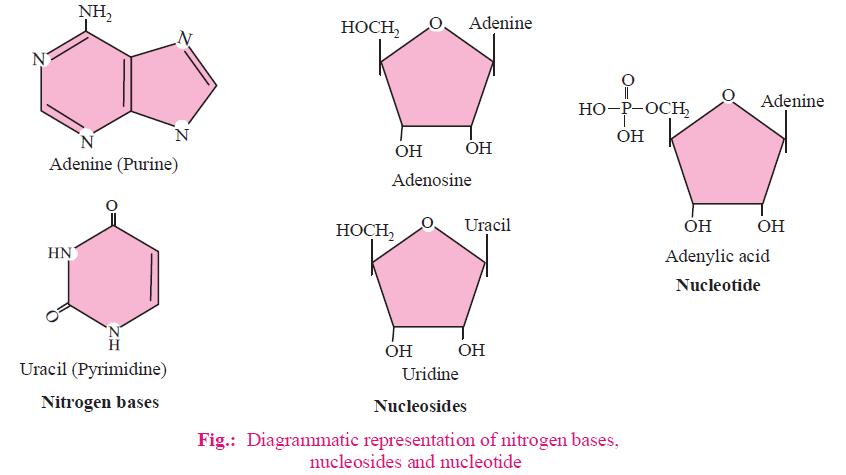
Nucleoside : Nitrogenous base + Sugar e.g., Adenosine, guanosine.


Nucleotide : Nitrogenous base + Sugar + Phosphate group. e.g., Adenylic acid, thymidylic acid.


Nucleic acid : Polymer of nucleotides - DNA and RNA.


Biomacromolecules : Biomolecules with molecular weights in the range of ten thousand daltons and above; found in acid insoluble fraction. Lipids are not strictly macromolecules as their molecular weights do not exceed 800 Da but form a part of the acid insoluble pool.


Proteins :
• Are polymers of aminoacids linked by peptide bond.
• Is a heteropolymer.
• For functions of proteins

(a) Primary structure : Is found in the form of linear sequence of amino acids. First amino acid is called N-terminal amino acid and last amino acid is called C-terminal amino acid.


(b) Secondary structure : Polypeptide chain undergoes folding or coiling which is stabilized by hydrogen bonding. Right handed helices are observed. e.g., fibrous protein in hair, nails.


(c) Tertiary structure : Long protein chain is folded upon itself like a hollow wollen ball. Gives a 3-dimensional view of protein, e.g., myosin.


(d) Quaternary structure : Two or more polypeptides with their foldings and coilings are arranged with respect to each other. e.g., Human haemoglobin molecule has 4 peptide chains - 2a and 2b subunits.


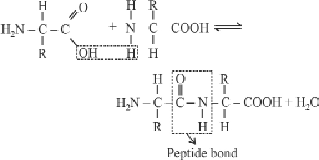
Peptide bond : Formed between the carboxyl (-COOH) group of one amino acid and the amino (-NH ) group of the next amino acid with the elimination of water moeity.

2 Polysaccharides : Are long chain of sugars.


(a) Starch : Store house of energy in plant tissues. Forms helical second- ary structures.
(b) Cellulose : Polymer of glucose.
(c) Glycogen : Is a branched homopolymer, found as storage polysaccharide in animals.
(d) Insulin : Is a polymer of fructose.
(e) Chitin : Chemically modified sugar (amino-sugars) N-acetyl galac- tosamine. Form exoskeleton of arthropods.


Anabolic pathways : Lead to formation of more complex structure from a sim- pler structure with the consumption of energy. e.g., Protein from amino acids.


Catabolic pathway : Lead to formation of simpler structure from a complex structure. e.g., Glucose → Lactic Acid.


Enzymes : Are biocatalysts.
• Almost all enzymes are proteins.
• Ribozomes - Nucleic acids that behave like enzymes.
• Has primary, secondary and tertiary structure.
• Active site of an enzyme is a crevice or pocket into which substrate fits.
• Enzymes get damaged at high temperatures.
• Enzymes isolated from thermophilic organisms (live under high temperatures) are thermostable.
• Enzymes accelerate the reactions many folds.
• Enzymes lower the activation energy of reactions.

• ES ES EP EP +→→+ where E = Enzyme, S = Substrate, P = Product.


Factors affecting enzyme activity :
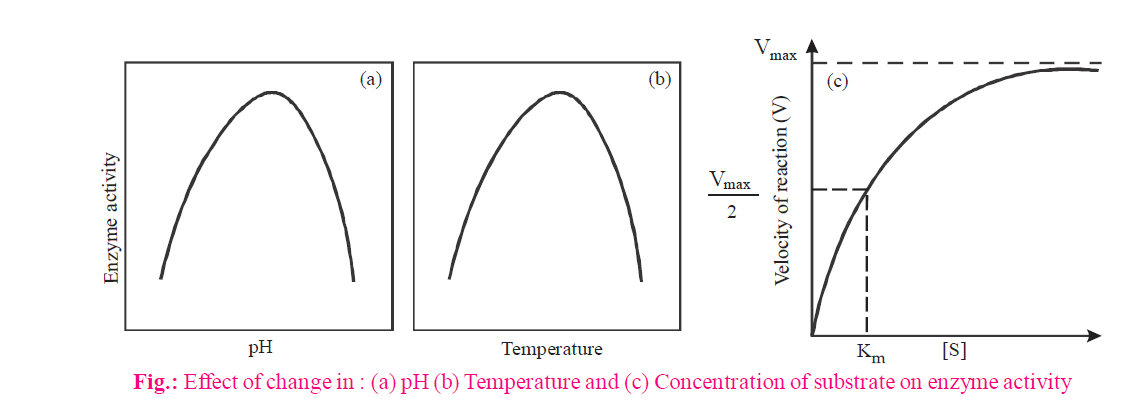
(a) Temperature : Show highest activity at optimum temperature. Activity declines above and below the optimum value.
(b) pH : Enzymes function in a narrow range of pH. Highest activity at optimum pH.


(Fig. 9.7, Page no. 157, NCERT, Text Book of Biology for Class XI)


(c) Concentration of substrate : The velocity of enzymatic reaction rises with increase in substrate concentration till it reaches maximum ve- ). Further increase of substrate does not increase the rate of reaction as no free enzyme molecules are available to find with additional substrate. locity


V max Enzyme inhibition : When the binding of a chemical shuts off enzyme activity, the process is called inhibition and chemical is called inhibitor.


Competitive inhibition : Inhibitor closely resembles the substrate in its molecular structure and inhibits the enzyme activity. E.g., inhibition of succinic dehydrogenase by malonate.


Classification of enzymes :


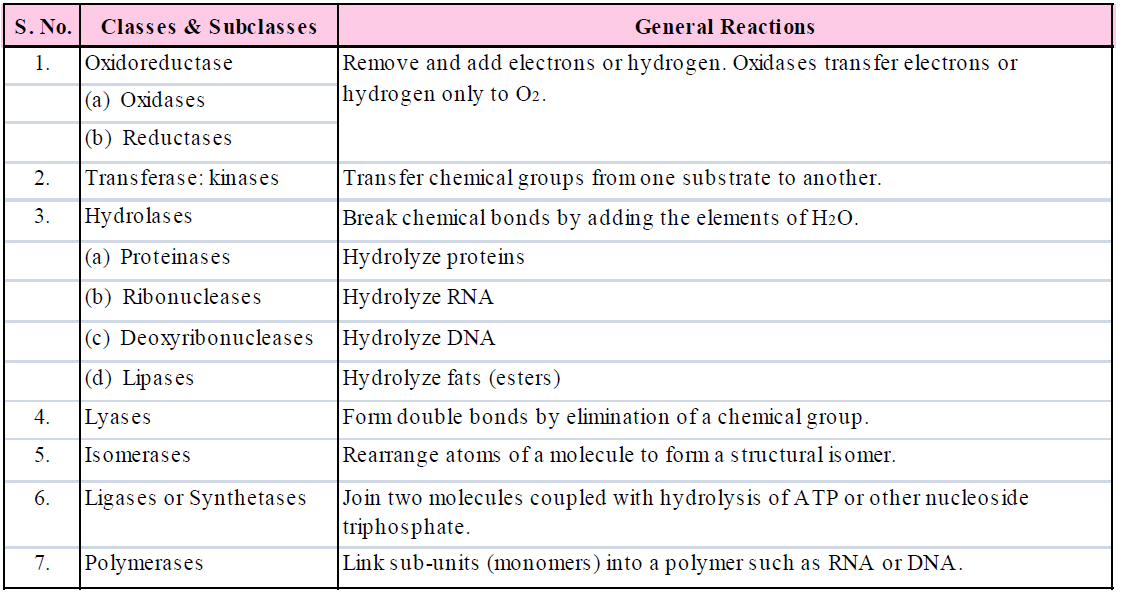
Oxidoreductase/dehydrogenases : Catalyse oxidoreduction between 2 sub- strates.


Transferases : Catalyse transfer of a group between a pair of substrates.


Hydrolases : Catalyse hydrolysis of ester, ether, peptide, glycosidic, C-C, P-N bonds.


Lyases : Catalyse removal of groups from substrates by mechanisms other than hydrolysis.


Isomerases : Catalyse inter-conversion of optical, geometric or positional isomers.


Ligases : Catalyse linking together of 2 compounds. Cofactors : Non-protein constituents found to the enzyme to make it cata- lytically active. Protein portion of enzyme is called apoenzyme.


Cofactors :
• Prosthetic groups : Are organic compounds tightly bound to apoenzyme. E.g., haem in peroxydase and catalase.
• Co-enzymes : Organic compounds which has transient association with enzyme. E.g., NAD, NADP.
• Metal ions : Required for enzyme activity. Form coordination bond with side chains at active site and with substrate.


E.g., zinc is a co-factor for enzyme carboxypeptidase.


18. Nucleic acids : Deoxyribonucleic acid (DNA) and ribonucleic acid (RNA). DNA structure (Watson and Crick Model) : DNA is a right handed, double helix of two polynucleotide chains, having a major and minor groove. The two chains are antiparallel, and held together by hydrogen bonds (two between A and T and three between C and G). The backbone is formed by sugar-phosphatesugar chain. The nitrogen bases are projected more or less perpendicular to this backbone and face inside.

Monday, November 9, 2020

Class XI Unit 6 BIOMOLECULES Topic-Nucleic Acid, Enzymes By Mr.Sarjerao Yedekar M.Sc BEd Zoology CTET

NUCLEIC ACIDS

  • Nucleic  acids are the polymers of nucleotide made up of carbon, hydrogen, oxygen, nitrogen and phosphorus which control the basic functions of the cell.
  • Miescher discovered nucleic acids in the nucleus of pus cell and called it nuclein. The name nucleic acid was proposed by Altman.
  • On the basis of structure, nitrogen bases are broadly of two types :
    • Pyrimidines : These consist of one pyrimidine ring. Skeleton of ring is composed of two nitrogen and four carbon atoms. E.g., cytosine, thymine  (in DNA) and uracil (in RNA).
    • Purines : These consist of two rings i.e. one pyrimidine ring (2N + 4C) and one imidazole ring (2N + 3C). E.g., adenine and guanine.

PENTOSE SUGAR
  • Nitrogen base forms bond with first carbon of pentose sugar to form a nucleoside, nitrogen of third place (N3) forms bond with sugar in case of pyrimidines while in purines nitrogen of ninth place (N9) forms bond with sugar.
  • Phosphate : Phosphate forms ester bond (covalent bond) with fifth carbon of sugar to form a complete nucleotide.
  • When nitrogen bases are found attached to a pentose sugar, then they are called nucleosides, e.g., adenosine, guanosine, thymidine, uridine and cytidine.
  • Nucleotides are phosphorylated nucleosides. These are formed by condensation of a pentose sugar, a nitrogen base and at least one phosphoric acid residue, e.g., adenylic acid, thymidylic acid,  guanylic acid, uridylic acid and cytidylic acid.
  • Nucleic acids like DNA and RNA consist of nucleotides only. DNA and RNA function as genetic material.

DNA (DEOXYRIBONUCLEIC ACID)

  • DNA was first identified and isolated by Friedrich Miescher. A nucleic acid containing deoxyribose is called deoxyribonucleic acid (DNA).
  • In DNA, pentose sugar is deoxyribose sugar and four types of nitrogen bases are Adenine (A), Thymine (T), Guanine (G) and Cytosine (C).
  • Wilkins and Franklin studied DNA molecule with the help of X-ray crystallography.
  • With the help of this study, Watson and Crick (1953) proposed a double helix model for DNA. For this model, Watson, Crick and Wilkins were awarded noble prize in 1962.
  • According to this model, DNA is composed of two polynucleotide chains. Both polynucleotide chains are complementary and anti-parallel to each other.
  • In both strands of DNA, direction of phosphodiester bond is opposite, i.e., if direction of phosphodiester bond in one strand is 3'-5' then it is 5'-3' in another strand.
  • Both strands of DNA are held together by hydrogen bonds. These hydrogen bonds are present between nitrogen bases of both strands.
  • Adenine binds to Thymine by two hydrogen bonds and Cytosine binds to Guanine by three hydrogen bonds.
  • Chargaff’s equivalence rule : In a double stranded DNA, amount of purine nucleotides is equal to amount of pyrimidine nucleotides.
Purine = Pyrimidine
[A] + [G] = [T] + [C]
Base ratio = = constant for a given species.

In DNA , A + T > G + C ⇒ A – T type DNA.
Base ratio of A – T type of DNA is more than one.
E.g.,  Eukaryotic DNA.

In DNA,  G + C > A + T ⇒ G – C type DNA.
Base ratio of G - C type of DNA is less than one.
E.g., Prokaryotic DNA.
  • Melting point of DNA depends on G – C contents.
More G – C content means more melting point.
Tm (melting temperature) of prokaryotic DNA > Tm of eukaryotic DNA.

CONFIGURATION OF DNA MOLECULE

  • Two strands of DNA are helically coiled like a revolving ladder. Backbone of this ladder (Reiling) is composed of phosphates and sugars while steps (bars) are composed of pairs of nitrogen bases. The strand turns 36°.
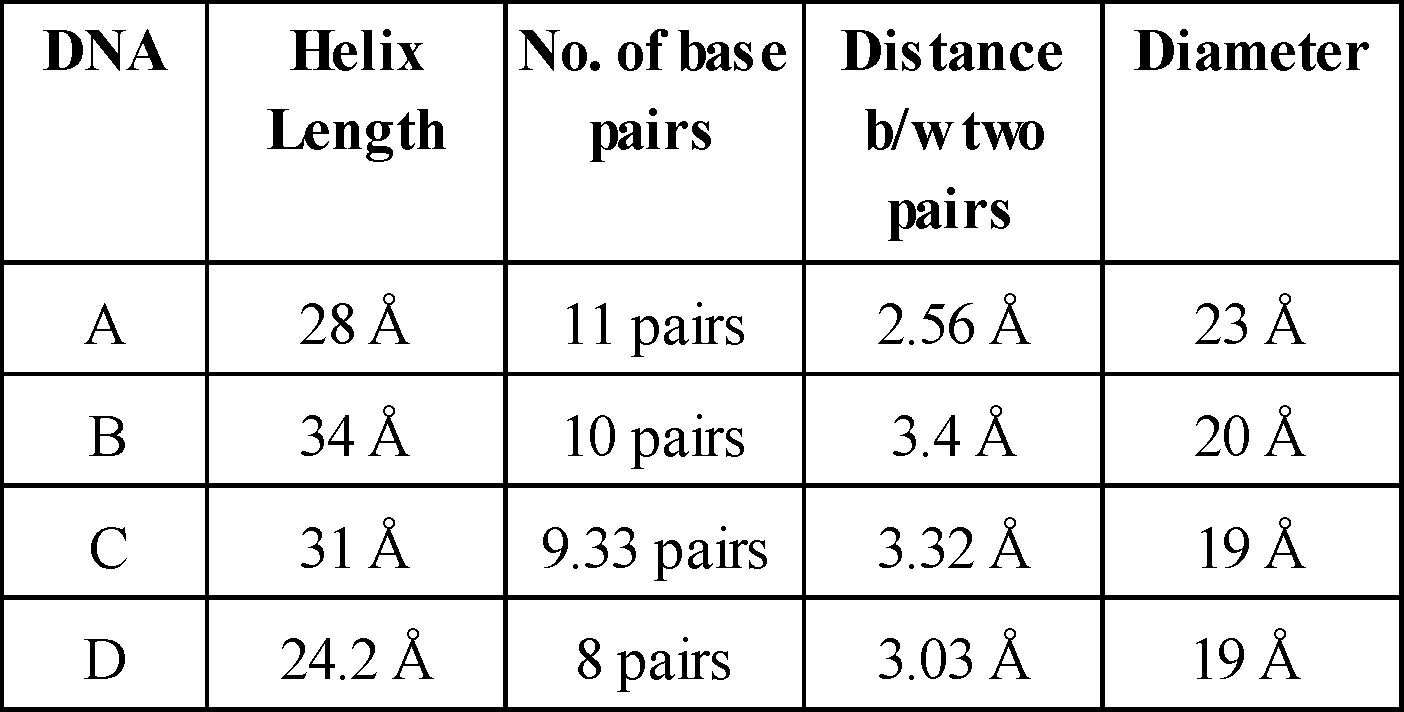
  • Distance between two successive steps is 3.4 Å,  In one complete turn of DNA molecule, there are 10 such steps
    (10 pairs of nitrogen bases). So, the length of one complete turn is 34 Å. This is called helix length.
  • Diameter of DNA molecule i.e., distance between phosphates of two strands is 20Å.
  • Distance between sugar of two strands is 11.1Å.
  • Length of hydrogen bonds between nitrogen bases is 2.8-3.0Å. Angle between nitrogen base and C1 carbon of pentose is 51°.
  • Molecular weight of DNA is 106 to 109 dalton.
  • In the nucleus of eukaryotes, the DNA is associated with histone proteins to form nucleoprotein.
  • Bond between DNA and histone is salt linkage (Mg+2).
  • DNA in chromosomes is linear while in prokaryotes, mitochondria and chloroplast, it is circular.
  • In φ × 174 bacteriophage, the DNA is single stranded and circular.
  • G-4, S-13, M-13, F1 and Fd - Bacteriophages also contain ss (single stranded) - circular DNA.

TYPES OF DNA

On the basis of direction of twisting, there are two types of DNA:

RIGHT HANDED DNA
  • Clockwise twisting e.g. The DNA for which Watson and Crick proposed model was B - DNA.
  • Other exmples of right handed DNA are –

LEFT HANDED DNA
  • Anticlockwise twisting e.g. Z-DNA-discovered by Alexander Rich.
  • Phosphate and sugar backbone is zig-zag.
  • Units of Z-DNA are dinucleotides (purine and pyrimidine in alternate order)
  • Helix length 45.6 Å,  Diameter - 18.4 Å
  • No. of base pairs : 12 (6 dimers)
  • Distance between base  pairs = 3.75 Å

FUNCTIONS OF DNA

DNA is vital for all living beings –  It is important for inheritance, coding for proteins and the genetic instruction guide for life and its processes. DNA holds the instructions for an organisms or each cell's development and reproduction and ultimately death.

NOTES
  • DNA molecule is Dextrorotatory while RNA molecule is Laevorotatory.
  • C-value = Total amount of DNA in a genome or haploid set of chromosomes.

RNA (RIBONUCLEIC ACID)

Structure of RNA is fundamentally the same as DNA, but there are some differences. The differences are :
  • In place of deoxyribose sugar of DNA, ribose sugar is present in RNA.
  • In place of nitrogen base thymine present in DNA, nitrogen base uracil is present in RNA.
  • RNA is made up of only one polynucleotide chain i.e., RNA is single stranded.
Exception : RNA found in reo-virus is double stranded, i.e., it has two polynucleotide chains.

TYPES OF RNA

GENETIC RNA OR GENOMIC RNA
In the absence of DNA, sometimes RNA working as genetic material and genomic RNA transfer information from one generation to the next generation.
E.g., Reovirus and Tobacco Mosaic Virus (TMV).

NON-GENETIC RNA
3 types : (a) r - RNA (b) t - RNA (c) m - RNA
(1) Ribosomal RNA (r - RNA)
  • This RNA is 80% of the cells total RNA.
  • It is found in ribosomes and is produced in the nucleolus.
  • At the time of protein synthesis, r-RNA provides attachment sites to t-RNA and m-RNA and attaches them on the ribosome.

(2) Transfer - RNA (t-RNA) / soluble RNA (sRNA) / adapter RNA
  • It is 10-15% of total RNA.
  • It is synthesized in the nucleus by DNA.

(3) Messenger RNA (m -RNA)
  • The m- RNA is 1-5% of the cell’s total RNA.
  • It is produced by genetic DNA in the nucleus. This process is known as transcription.

DYNAMIC STATE OF BODY CONSTITUENTS - CONCEPT OF METABOLISM

  • Metabolism is the set of life sustaining chemical transformations within the cells of living organisms. These enzyme - catalyzed reactions allows organisms to grow, reproduce, maintain their structures, and respond to their environments.
  • A few examples for such metabolic transformations are : removal of CO2 from amino acids making an amino acid into an amine, removal of amino group in a nucleotide base; hydrolysis of a glycosidic bond in a disaccharide, etc.
  • It is divided into 2 classes : Catabolism breaks down organic matter, e.g., to harvest energy in cellular respiration. Anabolism uses energy to construct components of cells such as proteins and nucleic acids.
  • Metabolites are converted into each other in a series of linked reactions by a sequence of enzymes called metabolic pathways.
  • In metabolic reactions, every chemical reaction is catalysed reaction. There is no uncatalysed metabolic conversion in living systems.
  • Metabolic Basis for Living
    • Metabolic pathways can lead to a more complex structure from a simpler structure (for example, acetic acid becomes cholesterol) or to a simpler structure from a complex structure (for example, glucose becomes lactic acid in our skeletal muscles).
    • Living organisms have learnt to trap energy liberated during degradation and store it in the form of chemical bonds. As and when needed, this bond energy is utilised for biosynthetic, osmotic and mechanical work that we perform. The most important form of energy currency in living systems is the bond energy in a chemical called adenosine triphosphate (ATP).

ENZYMES

  • Enzymes are biocatalysts made up of proteins (except ribozyme) which increases the rate of biochemical reactions by lowering down the activation energy, but does not affect the nature of final product.
  • The term enzyme (meaning in yeast) was used by Willy Kuhne (1878) while working on fermentation.
  • Zymase (from yeast) was the first discovered enzyme by Buchner.
  • The first purified and crystalized enzyme was urease
    (by J.B. Sumner) from Canavalia/Jack Bean (Lobia plant) and suggested that enzymes are proteins.

CHARACTERISTICS OF ENZYMES

  • All enzymes are proteins, but all proteins are not enzymes. Enzymatic proteins consist of 20 amino acids.
  • All enzymes are tertiary and globular proteins (isoenzymes quaternary protein). Their tertiary structure is very specific and important for their biological activity.
  • Enzymes accelerate the rate of reaction  without undergoing any change in themselves. Enzymes lower the activation energy of substrate or reactions.
  • Enzymes are macromolecules of amino acids which are synthesized on ribosomes under the control of genes.
  • Molecular weight of enzymes are high and these are colloidal substances.
  • Enzymes are very sensitive to pH and temperature. Optimum temperature for enzymes is 20-35°C. Most of the enzymes are active at neutral pH, hydrolytic enzymes of lysosomes are active at acidic pH (5).
  • Enzymes are required in very minute amounts for biochemical reactions.
  • Their catalytic power is represented by Michaelis Menten constant or Km constant and turn over number. ‘‘The number of substrate molecules converted into products per unit time by one molecule of the enzyme in favourable conditions is called turnover number.’’
  • Enzymes are very specific to their substrate or reactions.

STRUCTURE OF ENZYMES

  • Simple enzymes : These are exclusively made up of protein i.e., simple proteins.
E.g.,  pepsin, trypsin, papain.
  • Conjugated enzymes : Enzymes are composed of one or several polypeptide chains. However, there are a number of cases in which non-protein constituents called co-factors are bound to the enzyme to make the enzyme catalytically active. The protein part of the enzyme is called apoenzyme. There are 3 kinds of cofactors which are given as follows :
    • Co-enzymes : These are non-protein organic groups, which are loosely attached to apoenzymes. These are generally made up of vitamins, e.g., coenzyme nicotinamide adenine dinucleotide (NAD), nicotinamide adenine dinucleotide phosphate (NADP) contains the vitamin niacin, coenzyme A contains pantothenic acid, flavin mononucleotide (FMN), flavin adenine dinucleotide (FAD) contains riboflavin (Vitamin B2), and thiamine pyrophosphate (TPP) contains thiamine (Vitamin B1).
    • Prosthetic group : When non-protein part is tightly or firmly attached to apoenzyme. These are organic compounds. E.g., in peroxidase and catalase, which catalyze the breakdown of H2O2 to H2O and O.
    • Metal ions : Metal ions play an essential role in regulating the activity of enzymes by forming coordination bonds with side chains at the active site and at the same time form one or more coordination bonds with the substrate. E.g., Mn, Fe, Co, Zn, Ca, Mg, Cu.
  • Active site : Specific part of enzyme at which specific substrate is to bind and catalyse the reaction is known as an active site. Active site of enzyme is made up of very specific sequence of amino acids which is, determined by genetic codes.
  • Allosteric site : Besides the active site, some enzymes possess additional sites, at which chemicals other than substrate (allosteric modulators) bind. These sites are known as allosteric sites and enzymes with allosteric sites are called as allosteric enzymes, e.g., hexokinase, phosphofructokinase.

TERMS RELATED TO ENZYMES

  • Endoenzymes : Enzymes which are functional only inside the cells.
  • Exoenzymes : Enzymes catalysed the reactions outside the cell. E.g., enzymes of digestion, some enzymes of insectivorous plants, zymase complex of fermentation.
  • Proenzyme/Zymogen : These are precursors of enzymes or inactive forms of enzymes.
E.g., Pepsinogen, Trypsinogen, etc.
  • Iso-enzymes : Enzymes having similar action, but little difference in their molecular configuration are called isoenzymes. 16 forms of α-amylase of wheat and 5 forms of LDH (Lactate dehydrogenase) are known. These all forms are synthesised by different genes.
  • Inducible enzymes : When formation of enzyme is induced by substrate availability. E.g., Lactase, Nitrogenase, β-galactosidase.
  • Biodetergents :  Enzymes used in washing powders are known as bio-detergents, e.g., amylase, lipase, proteolytic enzymes.
  • Housekeeping / constitutive enzymes : These enzymes are always present in constant amount and are also essential to cell.

NOMENCLATURE AND CLASSIFICATION OF ENZYMES

MECHANISM OF ENZYME ACTION

  • Energy is required to convert the inert molecules into the activated state. The amount of energy required to raise the energy of molecules at which chemical reaction can occur is called activation energy.
  • Enzymes act by decreasing the activation energy so that the number of activated molecules is increased at lower energy levels. If the activation energy required for the formation of the enzyme-substrate complex is low, many more molecules can participate in the reaction than would be the case if the enzymes were absent.

MODE OF ACTION OF ENZYME

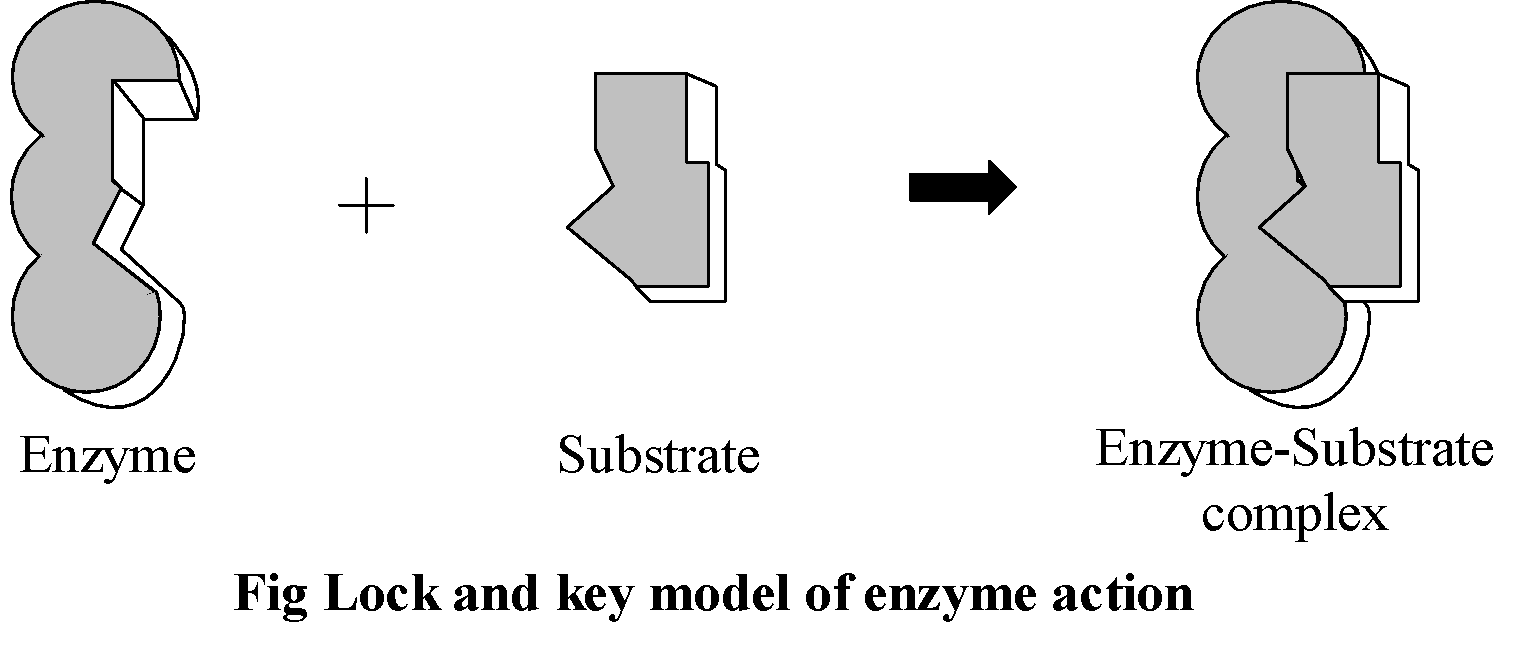
(1) LOCK & KEY THEORY OR TEMPLATE THEORY
  • The theory was given by Emil Fischer.
  • According to this theory, active sites of enzymes serve as a lock into which the reactant substrate fits like a key. Enzymes have specific sites where a particular substrate can only be attached. This model accounts for enzyme specificity.
(2) ENZYME - SUBSTRATE COMPLEX THEORY
In 1913, Michaelis and Menten proposed that for a catalytic reaction to occur it is necessary that the enzyme and substrate bind together to form an enzyme substrate complex.
It is amazing that the enzyme-substrate complex breaks up into chemical products different from that which participated in its formation (i.e., substrates). On the surface of each enzyme, there are many specific sites for binding substrate molecules called active sites or catalytic sites.

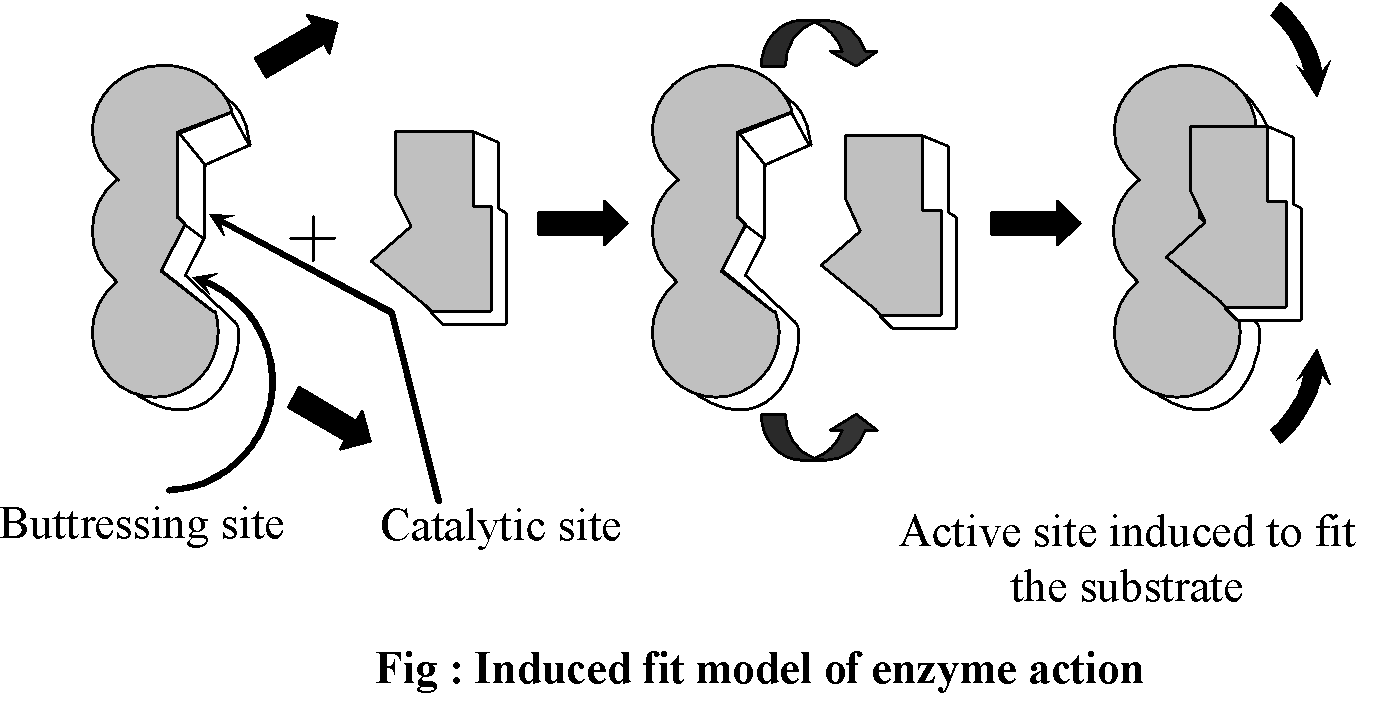
(3) INDUCED FIT THEORY
  • This hypothesis was proposed by Koshland (1959).
  • According to this theory, active site is not static but it undergoes a conformational change which is induced by specific substrate.

FACTORS / AFFECTING ENZYME ACTION

The activity of an enzyme can be affected by a change in the conditions which can alter the tertiary structure of the protein. These include temperature, pH, change in substrate concentration or binding of specific chemicals that regulate its activity.
  • pH : Enzymes are very sensitive to pH. Each enzyme shows its highest activity at optimum pH. Activity declines both below and above the optimum value.
  • Temperature : Low temperature preserves the enzyme in a temporarily inactive state whereas high temperature destroys enzymatic activity because proteins are denatured by heat. Generally  all enzymes perform better at body temperature of an organism.
  • Enzyme concentration : The rate of reaction is directly proportional to enzyme concentration. An increase in enzyme concentration will cause a rise in the rate of reaction upto a point and after which the rate of reaction becomes constant. Increasing the enzyme concentration, increases the number of available active sites.
  • Substrate concentration : Increase in substrate concentration increases the activity of enzymes until all the active sites of enzymes are saturated by the substrate molecules. Therefore, the substrate molecules occupy the active sites vacated by the products and cannot increase the rate of reaction further.

Km CONSTANT (MICHAELIS & MENTEN CONSTANT)
  • Km constant of an enzyme is the concentration of substrate at which rate of reaction of that enzyme attains half of its maximum velocity. It is given by Michaelis & Menten. The value of Km should be lower for an enzyme.
  • Km exhibits catalytic activity of an enzyme.
  • Km value differs from substrate to substrate because different enzymes differ in their affinity towards different substrates. A high Km indicates low affinity while a low Km shows strong affinity.
  • Protease acts on different proteins. So its Km value differs from protein to protein.
The Michaelis Menten equation describes how rate of reaction relatively varies with substrate concentration
V0 =
Where Vo  is the rate of initial reaction; Vmax is the maximum relative or the reaction rate with excess substrate; Km is the Michaelis constant = K2+K3/K1; [S] is the substrate concentration.

The above reaction shows that the greater the affinity between an enzyme and its substrate, the lower the Km (in units moles per litre) of the enzyme substrate reaction. Stated inversely, 1/Km is the measure of affinity of the enzyme for its substrate.

Class XI Unit 6 Biomolecules. Topic- Proteins By . Sarjerao Yedekar M.Sc BEd Zoology CTET

PROTEINS

  • Proteins are polypeptides. These are linear chains of amino acids linked by peptide bonds.
  • Essential elements in protein are C , H , O, N. Some contain sulphur(S) and phosphorus (P) also. The structural unit of protein is amino acid.
  • A protein is a heteropolymer and not a homopolymer.
  • Proteins are polymers of amino acids (Fisher and Hoffmeister). There are approximately 300 amino acids known to exist but only 20 types of amino acids are used in formation of proteins.
  • Each amino acid is amphoteric compound because it contains one weak acidic group – COOH and a weak alkaline group – NH2.
  • In protoplasm; free amino acid occurs as ions ( at iso - electric point). Iso - electric point is that point of pH at which amino acids do not move in electric field.
  • Amongst proteins, 'collagen' is the most abundant protein of animal world while 'RubisCo' (Ribulose Bisphosphate Carboxylase-Oxygenase) is the most abundant protein of biosphere.

AMINO ACIDS

  • The amino acids are 'structural units' as well as 'digestive end products' of proteins.
  • Amino acids are organic acids with a carboxyl group
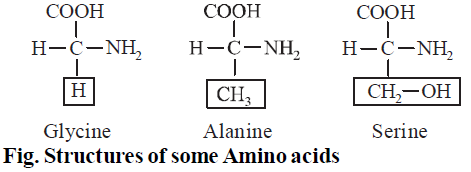
    (–COOH) and one amino group (–NH2)  on the α -carbon atom. Chemically, these are substituted  methane. Carboxyl group attributes acidic properties and amino group gives basic ones.
  • There are four substituent groups occupying the four valency positions. These are hydrogen, carboxyl group, amino group and a variable group designated as R group.
  • In solution, they serve as buffers and help to maintain pH. These are 20 in number, specified in genetic code and universal in viruses, prokaryotes and eukaryotes, which take part in protein synthesis,
  • Except glycine, each amino acid has two isomers.
                
  • Eukaryotic proteins have L- amino acid while D- amino acid occurs in bacteria and antibodies.
  • Amino acids join with peptide bond and form long chains called polypeptide chains.          

  • Peptidyl transferase enzyme catalyses the synthesis of peptide bond.

CLASSIFICATION OF AMINO ACIDS

Amino acids can be classified on the basis of their R (alkyl) group –
  • Non-polar R-group : Non-polar side chains consist mainly of hydrocarbons. Any functional groups they contain, are unchanged at physiological pH and are incapable of participating in H–bonding.
E.g., Alanine, valine, leucine, isoleucine, proline, methionine, phenylalanine, tryptophan.
  • Polar but uncharged R-group : Polar side chains contain groups that are either charged at physiological pH or groups that are able to participate in hydrogen bonding.
E.g., Glycine, serine, threonine, cysteine, tyrosine, asparagine, glutamine.
  • Positively charged polar R-group : These contain 2-amino and 1-carboxyl group.
E.g., Lysine, arginine, histidine (Basic Amino acid)
  • Negatively charged polar R-group : These contain 1-amino and 2-carboxyl groups.
Eg. Aspartic acid, glutamic acid (Acidic Amino acid)

 ◆PROPERTY OF PROTEIN DEPENDS
ON SEQUENCE OF AMINO ACIDS AND CONFIGURATION OF PROTEIN MOLECULES
  • Simple amino acids : These have no functional group in the side chain, e.g., glycine, alanine , leucine, valine etc. Glycine is the simplest amino acid.
  • Hydroxy amino acids : These have alcohol group in side chain, e.g., threonine, serine, etc.
  • Sulphur containing amino acids : These have sulphur atom in side chain, e.g., methionine, cysteine and cystine.
  • Basic amino acids : These have basic group (–NH2) in side chains, e.g., lysine, arginine.
  • Acidic amino acids : These have carboxyl groups in side chain, e.g., aspartic acid, glutamic acid.
  • Acid amide amino acids : These are the derivatives of acidic amino acids. In this group, one of the carboxyl group has been converted to amide (–CONH2), e.g., asparagine, glutamine.
  • Heterocyclic amino acids : These are the amino acids in which the side chain includes a ring involving atleast one atom other than carbon, e.g., histidine, proline and hydroxyproline.
  • Aromatic amino acids : These have aromatic group (benzene ring) in the side chain, e.g., phenylalanine, tyrosine and tryptophan.
ON THE BASIS OF REQUIREMENTS
On the basis of the synthesis of amino acids in the body and their requirement, these are categorized as :
  • Essential amino acids : These are not synthesized in the body hence need to be provided in the diet, e.g., valine, leucine, isoleucine, threonine, lysine, tryptophan, phenylalanine, methionine etc.
  • Semi-essential amino acids : Synthesized partially in the body but not at the rate to meet the requirement of individual, e.g., arginine and histidine.
  • Non-essential amino acids : These amino acids are derived from carbon skeleton of lipids and carbohydrate  metabolism. In humans, there are 12 non-essential amino acids, e.g., alanine, aspartic acid, cysteine, glutamic acid etc. proline and hydroxyproline have NH (imino group) instead of NH2 hence are called imino acids.

NOTES
  • All the amino acids are laevo-rotatory, except glycine which is non-rotatory.
  • Amino acids which participate in protein synthesis are called protein amino acids.  Amino acids which do not participate are called non-protein amino acids, e.g. GABA, ornithine, citrulline, thyroxine etc.

CONFIGURATION OF PROTEIN MOLECULE

(1) PRIMARY STRUCTURE
A straight chain of amino acids linked by peptide bonds form primary structure of proteins. The first (or left) amino acid is called N—terminal (–NH2 group.) amino acid, and the last (or right) amino acid is called C-terminal (–COOH group) amino acid. Such proteins are non functional proteins. This structure of proteins is most unstable. Newly formed proteins on ribosomes have primary structure.

(2) SECONDARY STRUCTURE
Protein molecules of secondary structure are spirally coiled. The spiral is stabilized by straight hydrogen bonds between imide group (– NH –) of one amino acid and carbonyl group
(– CO) of fourth amino acid residue. In this way, all the imide and carbonyl groups become hydrogen bonded.
  • α-helix : Right handed rotation of spirally coiled chain with approximately 3½ amino acids in each turn. This structure has intramolecular hydrogen bonding i.e. between two amino acids of the same chain e.g., keratin, myosin, tropomyosin.
  • β-helix or pleated sheath structure : Protein molecule has zig - zag structure. Two or more protein molecules are held together by intermolecular hydrogen bonding. The polypeptide chain may be parallel or antiparallel, e.g. Keratin protein in birds (β– sheets parallel) and silk protein (fibroin) with antiparallel β–sheets.
    • Proteins of secondary structure are insoluble in water and fibrous in appearance.
    • Keratin is a fibrous, tough, resistant to digestion sclero-protein. Hardness of keratin is due to abundance of cysteine amino acid in its structure.
(3) TERTIARY CONFIGURATION OR STRUCTURE
Proteins of tertiary structure are highly folded to give a globular appearance. These are soluble in water (colloid solution) giving us a 3–dimensional view of a protein. Tertiary structure is absolutely necessary for the many biological activities of proteins. Tertiary structure is stabilised by five types of bonds:
  • Peptide bonds : strongest bond in proteins.
  • Hydrogen bonds : These occur between hydrogen and oxygen atoms of various groups.
  • Disulphide bond : These bonds form between - SH group of amino acids (e.g., methionine, cysteine). These bonds are second strongest bond and stabilise the tertiary structure of protein.
  • Hydrophobic bonds : Present  between amino acids which have hydrophobic side chains, e.g. aromatic amino acids.
  • Ionic bonds : Formation of ionic bond occurs between two opposite ends of a protein molecule due to electrostatic attraction. Majority of proteins and enzymes in protoplasm exhibit tertiary structure.

(4) QUATERNARY STRUCTURE
Two or more polypeptide chains of tertiary structure united by different types of bonds to form quaternary structure of protein. Different polypeptide chains may be similar (e.g., lactic-dehydrogenase) or dissimilar types (e.g., haemoglobin, insulin). Quaternary structure is most stable structure of protein.

NOTES
Adult human haemoglobin consists of 4 subunits. Two of these are identical to each other. Hence, two subunits of α type and two subunits of β type together constitute the human
haemoglobin (Hb).

SIGNIFICANCE OF STRUCTURE OF PROTEIN

  • The most important constituents of animals are proteins and their derivatives.
  • In an acidic medium, the – COO– group of protein converts to – COOH and the protein itself becomes positively charged. In contrast, in an alkaline medium the – NH3+ group of protein changes to – NH2 + H2O and as a result it becomes negatively charged. Therefore, at a specific pH, a protein will possess an equal number of both negative and positive charges and it is at this specific pH, a protein becomes soluble.
  • If the pH changes towards either acidic or alkaline side, then the protein begins to precipitate. This property of protein has a great biological significance. The cytoplasm of cells of organism has an approximate pH of 7 but the pH of proteins present in it is about 6 and thus, the proteins are present in a relatively alkaline medium. Therefore, the proteins are negatively charged and also are not in a fully dissolved state. It is because of this insolubility, proteins form the structural skeleton. Similarly, the pH of nucleoplasm is about 7 but the pH of proteins, namely, histones and protamines, in it is relatively more. Therefore, as a result they are positively charged and do not remain fully dissolved in the nucleoplasm forming minute organelles, the most important being the chromosomes.
  • Such compounds which exhibit both acidic and alkaline properties are called amphoteric compounds or zwitterions. In the protoplasm, this dual property of proteins is utilized for neutralization of strong acids and alkalis since the protein acts as an ideal buffer in either of the situations.
Besides changes in pH, salts, heavy metals, temperature, pressure, etc. also cause precipitation of proteins.

TYPES OF PROTEINS

SIMPLE PROTEINS
Proteins which are composed of only amino acids.and it's Derivative
  • Fibrous Proteins :  E.g., Collagen, elastin, keratin
  • Globular Proteins : E.g., Albumin, histones, globin, protamines, prolamines (Glaidin, Gluten, Zein), Gluteline (slimy part of gluten of wheat).

CONJUGATED PROTEINS
Formed by the binding of a simple protein with a non-protein part (prosthetic group).
  • Nucleoproteins - Proteins attached to nucleic acids, e.g., chromatin, ribosomes etc.
  • Chromoprotein - Proteins with pigment or coloured, e.g., haemoglobin, haemocyanin, cytochromes etc.
  • Lipoprotein - Proteins combined with lipids, e.g., cell membrane, lipovitelline of yolk.
  • Phosphoproteins - Proteins containing phosphorus – e.g., casienogen, pepsin, ovovitelline, phosvitin.
  • Glycoproteins – Proteins combined with carbohydrates, e.g., hormones like FSH, LH, TSH and HCG, blood group antigens, serum protein etc.
  • Metallo-protein : Proteing with metal ions –e.g., Cu-tyrosinase, Zn-carbonic anhydrase, Mn-arginase, Mo-xanthine oxidase, Mg-kinase.

DERIVED PROTEINS
These form by denaturation or hydrolysis of protein.
  • Primary derived proteins are denaturation products of normal proteins, e.g., fibrin, myosin.
  • Secondary derived proteins are digestion products of proteins, e.g., proteoses, peptones.

FUNCTIONS OF PROTEINS

  • Formation of cells and tissues for growth.
  • Repairing of tissues.
  • Formation of hormones.
  • For muscle contraction (e.g., actin, myosin).
  • Formation of enzymes.
  • Help in blood clotting.
  • For transport (e.g., haemoglobin, transferrin).
  • For defence against infections (e.g., antibodies).
  • Form hereditary material – nucleoproteins.
  • For storage (e.g., myoglobin and ferritin).
  • For support (e.g., collagen and elastin).

Difference Between Anabolism And Catabolism

Differences between Catabolism and Anabolism    Mr.Sarjerao Yedekar (M.Sc BEd Zoology MH-SET,CTET,P.Hd Apperd) Comparison between  Catabolis...